Imagine if you had to physically visit a bank branch every time you wanted to check your balance or transfer funds. The commute and the queues would be unbearable. Or, imagine if you had to visit every single airline website individually just to find the cheapest ticket. Sounds frustrating, right?
What is an API?
APIs, or Application Programming Interfaces, are the invisible players every time you hit the 'Check Balance' button, transfer money to a friend, or check flight prices. Different software systems communicate and interact with each other using these APIs. For example, when you check your balance, your mobile banking app sends a request to the bank's API server. The bank's server then sends back a response to your app. The entire communication happens via APIs. If APIs didn't exist, there would be no way for you to interact with your bank digitally.
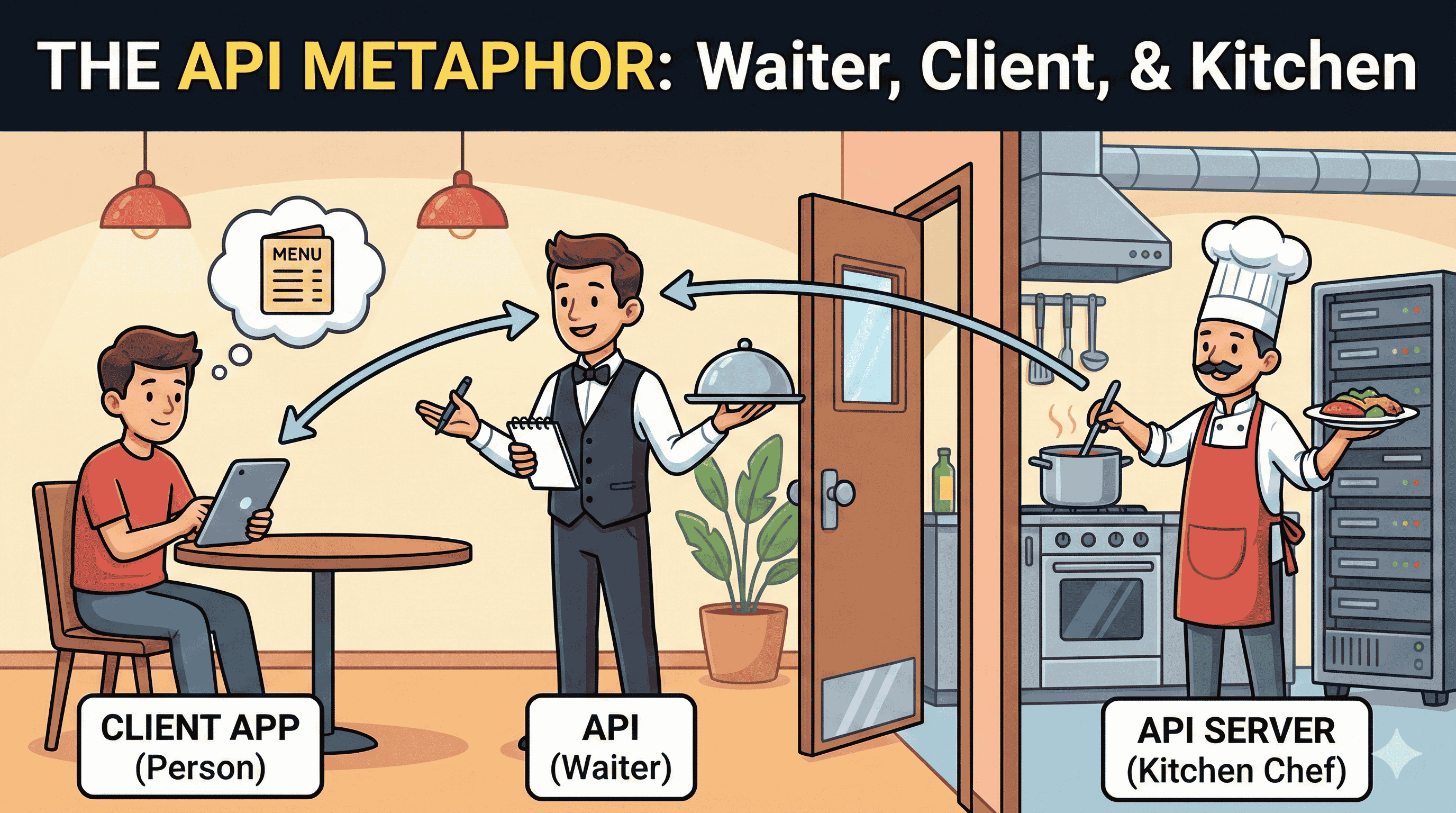
Think of it like a restaurant:
Imagine you (the Banking App) are sitting at a table ordering food (Data). You tell your order to the waiter (the API), who takes it to the kitchen (the Server). The kitchen cooks the food, and the waiter brings it back to you. You never enter the kitchen yourself; the entire communication happens through the waiter. Simple, right?
Why use APIs?
You might wonder: Why doesn't the banking app just connect directly to the bank's database? Or why doesn't a travel app connect directly to the airline's servers? There are three main reasons:
- Security: Direct connections introduce massive risks. If an app had direct access to a bank's database, a hacker could corrupt or steal sensitive data. APIs act as a gatekeeper; they ensure the app asks for permission before touching any data.
- Simplicity (Decoupling): APIs simplify the experience by decoupling the complex server-side processing from the user-facing app. The app developer doesn't need to worry about the bank's complex mainframe code; they just need to know how to ask the API for a balance.
- Reusability: APIs are reusable. Once a "Check Balance" API is built, it can be used by the mobile app, the website, and even the ATM. This saves time, money, and effort by not having to rebuild the same solution for every new device.
Types of APIs
Not all APIs are open to everyone. We typically categorize them into three types based on accessibility:
- Private (Internal) APIs: These are used exclusively by internal teams within an organization. For example, a bank might have an internal API that the payroll department uses to calculate employee salaries.
- Partner APIs: These are shared only with specific business partners who have authorization. A classic example is a travel aggregator app connecting to an airline's API to book tickets on your behalf.
- Public (Open) APIs: These are available for any external developer to use. Popular examples include the Google Maps API (for maps) or the Spotify API (for music data).
In today's fast-paced digital world, APIs are the engines driving business growth. Developers are the craftsmen building these invisible bridges. Whether you plan to build a new API solution to help a business, or simply use an existing one to solve a problem, there has never been a better time to get started. Follow for more insights on software development.